
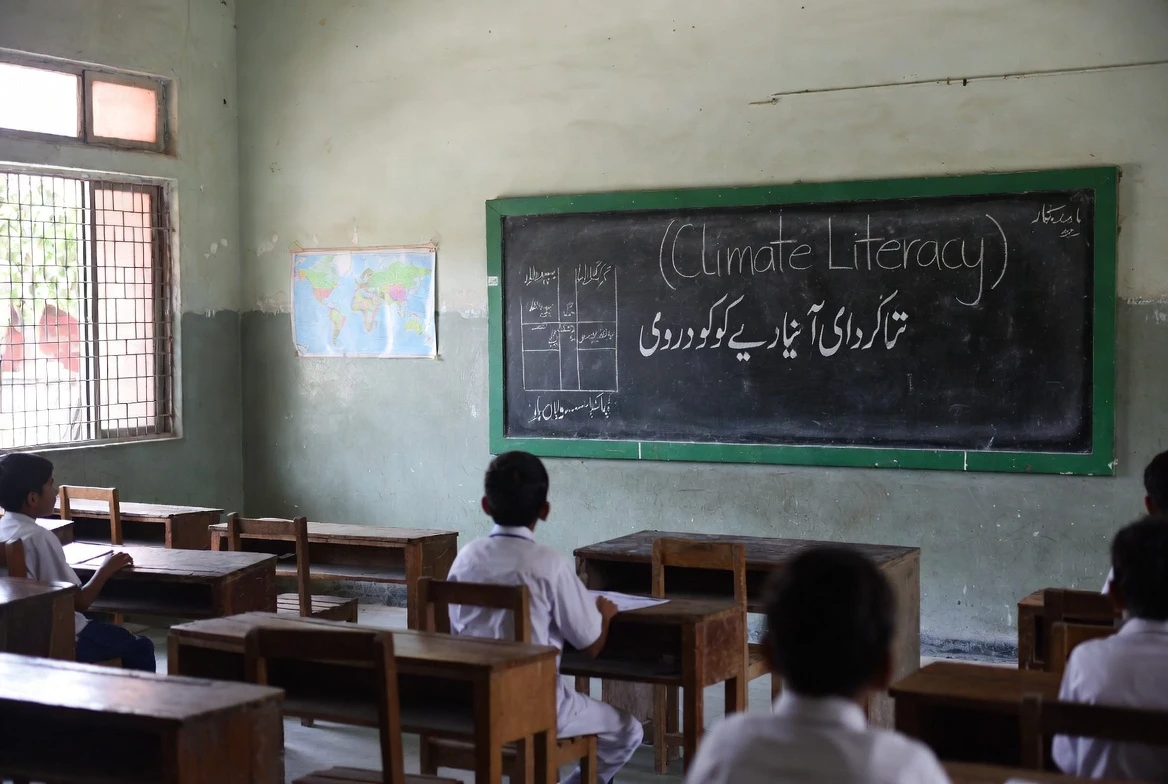
PROF. MUHAMMAD ISHAQ SAQI – Pakistan must not be able to afford climate change any longer. The smog of Lahore, flood in Sindh, drought in Balochistan, melting glacier in the north of Pakistan and increased heat stress in Pakistan can be realized. However, climate change is still to be infused as a minor subject, restricted to a chapter in science or geography textbook. This must change. Climate literacy needs to be incorporated into the school, college and university education of Pakistan.
Being climate literate does not mean that one knows what global warming is. It involves an understanding of impacts of climate change on water, food, health and agriculture, urbanisation and migration, gender, disaster risk management and economic growth. A student who is educated should be able to know the reasons as to why Lahore is a smog city, why floods are increasing, why heatwaves are impacting on education and how the societies will cope with the environmental risks.
Climate education is currently at a high level in Pakistan but more theoretical. They know about the greenhouse gasses, deforestation and pollution, but are not directed on how to apply the same to the locality. A student of Lahore needs to be educated about air pollution and transportation. A Sindhi student will have to be informed about the safety of floods. Balochistan student should be educated on water conservation. Gilgit-Baltistan student ought to be educated on the hazards of glaciers.
National Climate Change Policy 2021 as already acknowledged in Pakistan acknowledges the work of education, training and other awareness raising in adjusting to the climate change. The challenge is to implement it. The basic questions to be learnt at the primary school level climate change are planting of trees, garbage disposal, water, energy and heatstroke. The climate change should be introduced in high school in science, social studies, Pakistan studies, economics and ethics.
Universities, as well, play a significant part. Environmental science does not deal with climate change. It is related to education, engineering, agriculture, public health, law, and economics, media and public administration. The teachers ought to be trained how to teach about climate change, the engineers ought to be in a position to create installations resistant to heat, the medical practitioners ought to be taught on how to be aware and know only about heat diseases and the media ought to be able to write clearly on climate science.
The teachers will have to be trained. nothing without training of teachers. We need aspects of climate education during pre-service trainings and in-service educator training, but its local level, Urdu and regional language resources, basic experiments and resources online.
Evaluation too, must develop. They will repeat the definitions in case they are questioned, during exams, on what climate change is. They will be critical, just in case they are made to resolve issues in their respective neighbourhoods, in case they are obligated to undertake exams. Board and universities should offer project work, case studies and applied assessments like the creation of a school plan to respond to heatwaves or a brainstorming session that should reduce the number of plastic waste.
Climate literacy is a righteous cause, as well. The most victimized climate change-related outcomes that are not brought about by the underprivileged communities include floods, heatwave, disease and displacement. In the event of disasters destroying schools, or dislocation of their parents, girls are usually derailed in their studies. This is why a sense of understanding, activism and agency must be encouraged as well in climate education.
Pakistan can not afford to be uneducated graduates. Green schools and colleges can be established, climate literacy taught as a compulsory subject in the university, and textbook boards may update their curriculum. Climate change is not only an environmental crisis, but also an educational emergency. There is need now to have climate literacy in education. It is mandatory in the country.
You might also like