
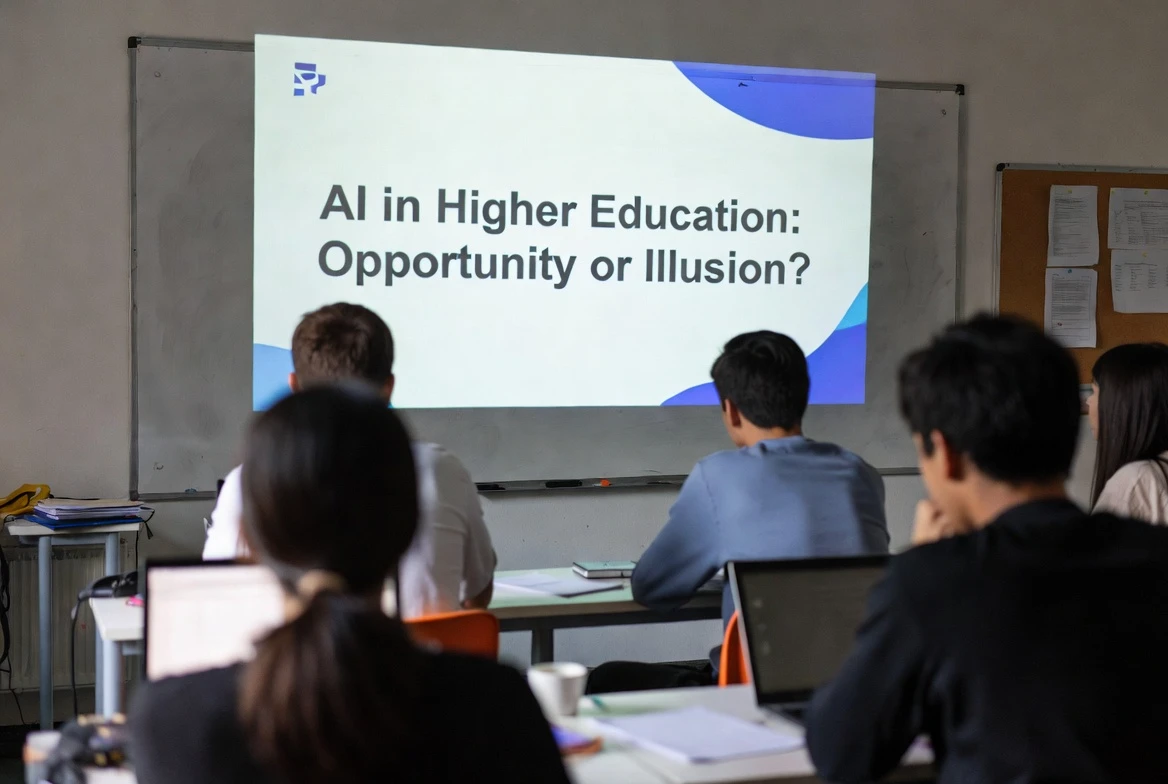
PROF DR. MADIHA BATOOL – The field of higher education in Pakistan is one of the most debated aspects in regards to the use of Artificial Intelligence. Universities are creating courses in AI, students are completing assignments with AI, educators are testing automatic feedback and policy makers posit AI as an economic revitalization. But the question is, will AI become a reality in the world of higher education, or just another good piece of marketing?
Some very significant measures have been taken by Pakistan. In 2026, the Higher Education Commission has instructed universities to incorporate a three-credit-hour AI course in both undergraduate and postgraduate programmes, which will be mandatory. The National AI Policy also seeks to encourage AI and other related technologies research and skills development by offering scholarships. These efforts are most welcome, but policy announcements are not enough to change universities.
The actual test is implementation. Most universities continue to be without trained faculty, and up-to-date laboratories, dependable internet, good data, research grants and good industry connections. In case such gaps are left, AI can turn into yet another hypothetical topic where learners can memorise definitions without acquiring real skills.
When used in the appropriate manner, AI can facilitate learning. It may assist learners to digest challenging ideas, translate the academic content, rehearse the writing process, analysis of data and fast feedback. It can be utilized to assist teachers to prepare lesson plans, quizzes and learning resources. It can help researchers to organise literature, enhance writing and aid data analysis.
Nevertheless, AI may destroy education as a shortcut, as well. Unless it is used as an assignment-generation tool by students, in order to read or copy ready-made answers, it will ruin originality and critical thinking. Higher education is not to create machine-written answers but to make a human judgment, imagination, morality and problem-solving capacity.
Thus, AI literacy should not be limited to the elementary computer literacy. Students are expected to understand how to be responsible when using AI and how to counterfeit and trust information, prevent plagiarism and safeguard privacy and recognise bias. It is significant in every field, such as medicine, law, engineering, education, business, social sciences and media studies.
Universities also should have distinct academic policies. When AI are permitted to be used, when not, and the manner in which they are to be recognized should also be disclosed by teachers. In the absence of well-defined regulations, academic dishonesty and academic support will become even more mixed up.
Training of the faculty is also necessary. In case it is not done by providing training to the teachers, AI courses would be superficial. Pakistan requires AI pedagogy, assessment design, data ethics and AI implementation in subject specific applications, teacher development programmes. Various AI skills will be required by a medical teacher, law teacher, education teacher and journalism teacher.
The other is the issue of inequality. Especially elite universities can implement AI fast whereas the underfunded or even poorer universities can lag behind. This has the potential to increase the digital divide. The reform of AI should therefore entail the investment in the public universities and particularly those which are not situated in large cities.
In the case of Lahore, it is particularly of concern. The city is a large technological and educational centre. Its higher education institutions can turn into applied AI health, education, climate, business and public policy centres. It will only occur when there is support of AI courses with lab, trained teachers, industry collaboration, and practical projects.
Neither is AI in higher education a magic wonder nor an illusion. It is an opportunity when there is an investment in people, infrastructure, ethics and implementation in Pakistan. Otherwise, it will be yet another trendy word on the policy pages. The decision is quite obvious: Pakistan will either make AI a practical academic change, or transform it into another catchphrase in the teaching plan.
You might also like