
Prof. Muhammad Ishaq, Educationist …This is a period the evaluation of learning was primarily based on observable effort. A good student was one who would rise late in the morning, stuff notebooks with long answer questions, stuff pages of texts in his heart and devote hours and hours correcting lessons. The only formula of success that was welcomed in most of the homes and classes was hard work. Nevertheless, as the age of automation comes, the picture of learning is changing. Education is not moving in the same direction that industry will move it, it is moving to efficiency, plan and intelligent use of means. Simple word learning could be said to be moving towards smart work rather than hard work.
This does not mean that the element of effort is no longer relevant. This means that work is being refigured. In the modern world, students are exposed to the world where it is possible to access the information within several seconds. The hours that would have been spent in a library are now possible to study using online journals, education videos and online notes and interactive systems. Automation has reduced the number of tasks which are time consuming and repetitive. Consequently, it is anticipated that students not only work hard, but also work wisely.
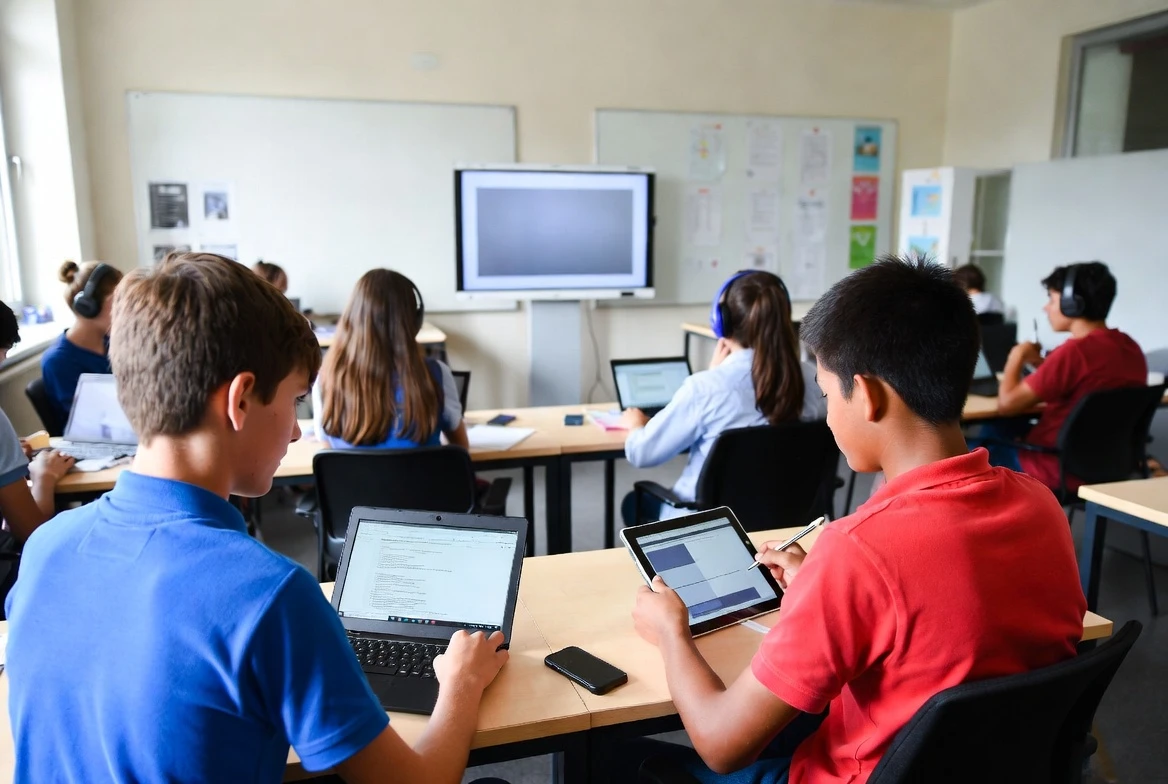
Classroom today is very different as compared to the one of yesterday. Technology has now assisted in areas of attendance, testing, grading, research and even lesson delivery. Tools of artificial intelligence might be used to clarify the concepts, create tasks of practice and assist the students in planning their studying activities. This has changed the kind of learner-a kind of learner that must be familiar with where, how to filter and use knowledge as opposed to memorizing. The more successful pupil is not always the one who is merely more obstinately persistent in the fight but the student who learns, in this type of a world.
This is not merely a realistic change but it is also necessary. Robots are rapidly getting faster in doing menial tasks. Automation is much more efficient in calculating, sorting, retrieving and repeating much more than a human being is. Therefore, it is no longer possible to perceive education value as being comprised of memorization and mechanical practice. Learning has become a reality now with the aim of knowing, being able to analyze, create and apply. The elements that the students are required to acquire; i.e., critical thinking, judgment, communication and innovation can hardly be replaced by technology.
This is why, smart learning is the need of the time. Smart learning can be defined as the existence of clear goals, time management, use of effective resources and focus on concepts in comparison to rote learning. It entails reserving part of time with the help of digital tools and making use of the time so reserved to think more. When a student studies in a directional, planned and purposeful way, he/she will do better than the student who studies long and is not directional. The current world appreciates productivity as opposed to busyness.
This change is being felt by teachers as well. They no longer have the responsibility of just imparting information out of a textbook. With the era of automation, educators are gradually turning into mentors that assist students to make sense of information, to solve problems and to relate knowledge with the real world. The modern day teacher is required to promote inquiry, discussion and self learning as opposed to rote learning. This is a good development as it will prepare the students with a future that will demand flexibility and not command and follow the order strategy.
In the meantime, the tendency towards intelligent work must be taken with a grain of salt. It should not be assumed to be synonymous with laziness or taking the shortcuts. Technology can assist in studying but not to substitute the discipline, honesty and concentration. The student is able to apply the available best tools, but will never experience any learning without being serious and exerting an effort on his/her part. Smart work does not imply the opposite of hard work, hard work but more effectively.
Such issue is especially acute in the countries, where the level of education is high, and where the level of competitiveness is growing, like in Pakistan. The students in these cities such as Lahore are normally subjected to congested schedules, anxiety and time constraints in the tests. Smart learning is not a luxury to them, but is a new need. Through strategic learning and proper use of technology in schools, colleges and universities, students will be in a better position to deal not only with the local problems, but also with global problems.
Even parents should revert the meaning of serious learning. Even now so many individuals equate quality education with blatant struggle–hours, more pages, more exhaustion. But in a dynamic world learning that is meaningful is perhaps less uninhibited and more focused. A student, who is learning with the help of digital tools, a student, who is learning through simulations, or a student, who is effectively learning with the help of learning through concepts, he/she is likely to be learning a lot more than a student, who is simply reading the same notes over and over again. It is not on the ability of a student to get tired, but on the competency of a student which is the learning measure.
The concept of education is being redefined by the age of automation in which education is seriously changing in front of our very eyes. It is educating us that only doing more cannot make us successful, but better. Hard work, however, will never be a disgrace, but intelligent work has become a compulsion. The future of such learners who can combine hard work with smartness, discipline with plan and technology with human knowledge is the future. It is the real changing of knowledge of our era.
You might also like
3 Comments
Leave A Reply
Cancel Reply
Great job Dear Uncle ☺️
Yes HE IS A BEST AND GOOD TEACHER
“Smart Learning” is a well-written and insightful article by Prof. Muhammad Ishaq saqi that truly reflects his experience as an educationist. He beautifully explains how learning is changing in the modern age. His ideas are practical, inspiring, and meaningful for students. The article shows his deep concern for education and student success.